
If you have ever been called out at midnight to lift a sewage pump out of a wet well because a rag jammed the impeller, you already know the real cost of clogging: emergency labour, downtime penalties, flooded pits and a pump that reaches the end of its service life far too early. A non clog sewage submersible pump exists to end that cycle. It is engineered to pass soft solids, fibres and debris with the liquid instead of letting them build up at the impeller — which is exactly what your maintenance team and your project budget need.
This article walks you through how a non clog design handles solids, which impeller type fits your medium, what free-passage size to specify, and where these pumps typically fail when they are misapplied. If you are comparing suppliers right now, you can use CDUN Pump’s WQ series non clog sewage submersible pump as a reference specification while you read.
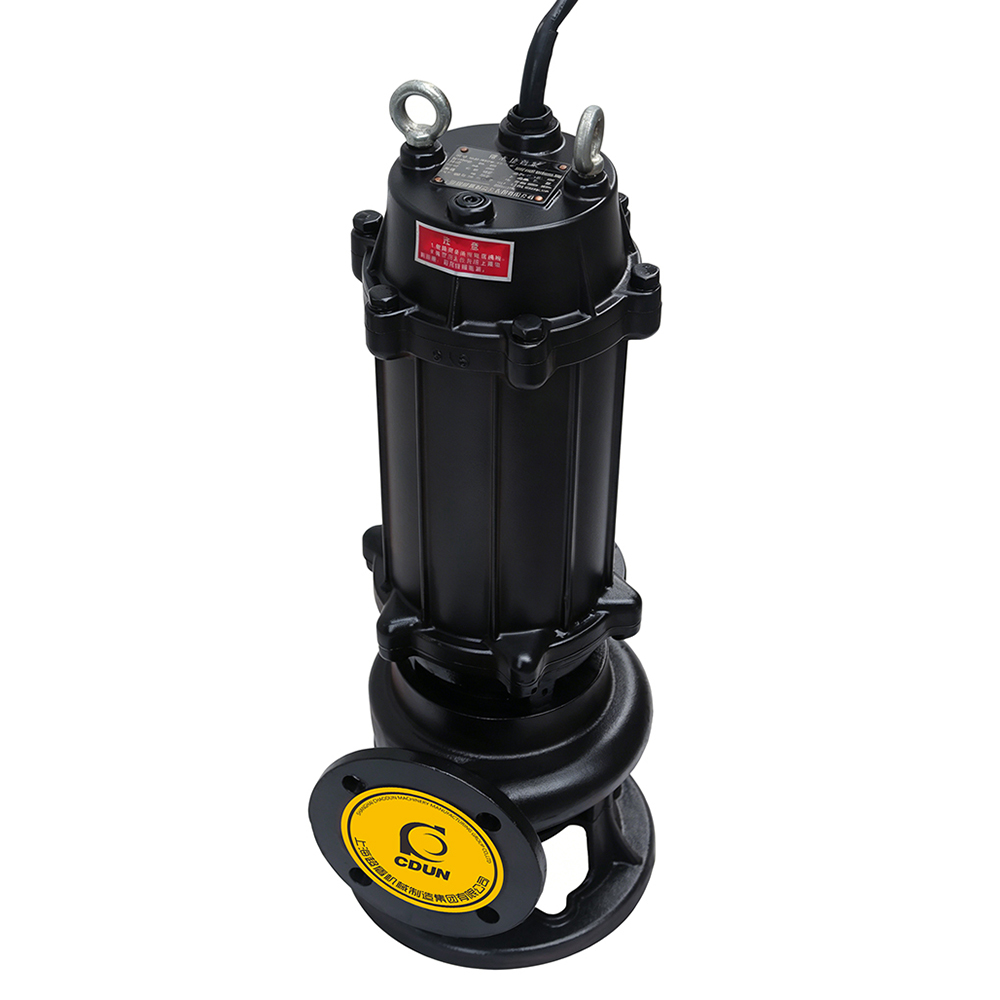
What Is a Non Clog Sewage Submersible Pump?
A non clog sewage submersible pump is a fully sealed unit — electric motor and hydraulic end in one housing — that operates completely submerged in raw wastewater and is designed to move liquids containing soft solids without those solids blocking the impeller or volute. Where a clean-water pump would jam within minutes, a non clog pump is built around one question: how do you keep the largest object in the medium moving from the inlet to the discharge without it getting stuck?
You will recognise a non clog design by a few signature features:
- Large free-passage impeller. One to three heavy vanes, or a fully recessed vortex impeller, sized so soft solids can travel straight through.
- Enlarged volute. The spiral casing is wider than the impeller channels, so nothing accumulates at the cutwater.
- Dual mechanical seals in an oil chamber. Wastewater is abrasive and corrosive; the seal arrangement protects the motor windings even if the outer seal wears.
- Robust materials. Cast iron housings, hardened impellers and stainless fasteners cope with grit and chemical attack.
For your business, that combination matters because it converts directly into fewer blockage call-outs, longer service intervals and a lower total cost of ownership across municipal pumping stations, industrial effluent lines and building drainage systems. If you would like a refresher on the underlying technology first, our guide to how a submersible pump works explains the operating principle step by step.
Vortex vs Channel vs Grinder: Which Impeller Stops Clogs?
Of all the sewage pump impeller types available, the one you choose has more influence on clog-free operation than any other single specification. The three families you will shortlist between are vortex, channel and cutter/grinder designs — and they solve the solids problem in fundamentally different ways.
| Impeller Type | How It Handles Solids | Best Suited For | Watch-Outs |
|---|---|---|---|
| Vortex (recessed) | Impeller sits recessed in the volute; it drives the water, and the water carries the solids. Most solids never touch the vane. | Ragged municipal sewage, fibrous media, long suction lines | 2–8% lower efficiency than channel designs |
| Channel (1–3 vane) | Wide, back-swept channels let soft solids pass through the impeller itself. | General raw sewage with predictable solids | Stringy rags can wrap long vanes over time |
| Enclosed multi-vane | Shrouded vanes give high hydraulic efficiency on finer media. | Effluent, secondary/treated wastewater, light sludge | Smallest free passage of the three — not for raw sewage |
| Cutter / grinder | A cutting ring macerates fibres and solids before they reach the impeller. | Industrial effluent, food and textile waste, small-bore pressurised lines | Higher power draw; cutting tools need periodic service |
A vortex sewage pump is the go-to answer when your medium is unpredictable. Because the impeller is recessed out of the main flow path, rags, wipes and stringy fibres are swept through with the water instead of wrapping around a vane — that is the core of the vortex design’s clog resistance. The trade-off is a small efficiency penalty, which is usually cheap insurance in a municipal wet well.
The grinder pump vs sewage pump question comes down to your discharge line. A grinder macerates everything into a fine slurry so it can be pushed through small-diameter, high-pressure pipes; a sewage pump passes solids whole through a much larger bore at lower energy cost. For most municipal and building duties, passing solids whole is cheaper to run and simpler to maintain. But when your effluent contains fibres that genuinely must be chopped — textile waste, food processing lines, or a pressurised lateral with a small pipe.
What Size Solid Can It Pass?
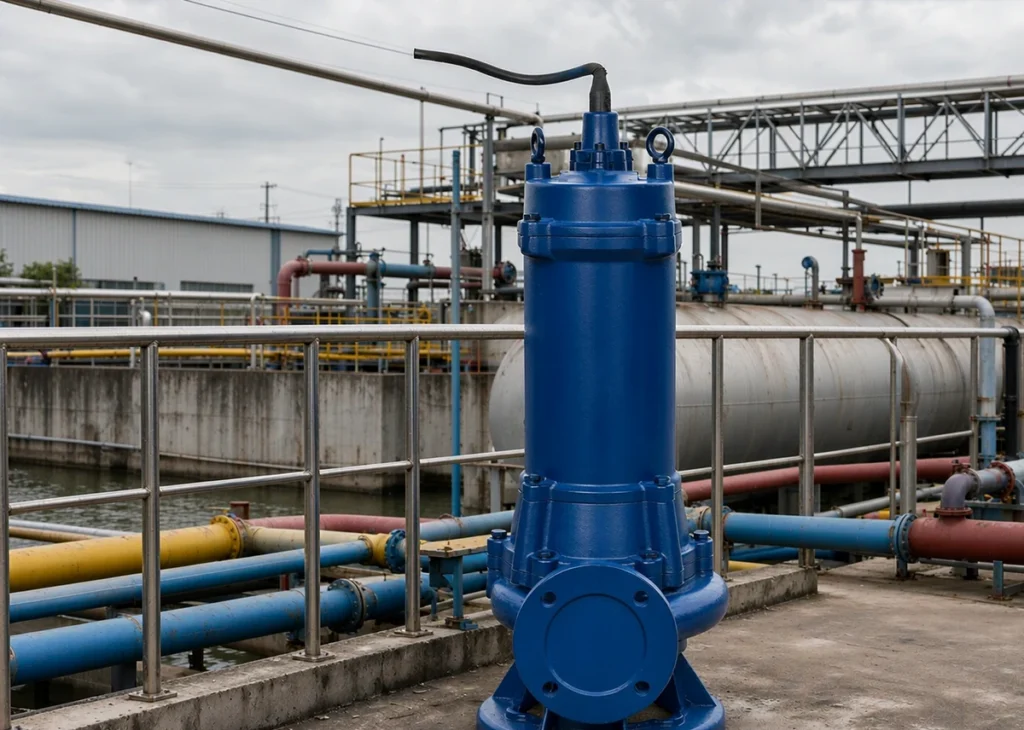
Non clog pump solids handling is specified as the maximum free-pass sphere diameter — the largest solid sphere that can travel from the flange inlet to the discharge without touching the impeller. This figure is tied to the discharge bore, and it is the number you should put on your procurement sheet before comparing any two models. European specifiers often anchor it to EN 12050, the standard for wastewater lifting plants, which sets minimum free-passage requirements depending on whether the unit handles wastewater with or without faecal matter — so confirm which part of the standard your project references before you shortlist.
| Discharge Bore | Typical Free-Pass Sphere | Typical Medium | Typical Application |
|---|---|---|---|
| 50 mm (2″) | 20–30 mm | Grey water, light effluent | Basement drainage, small lift stations |
| 80 mm (3″) | 35–50 mm | Raw municipal sewage | Community sewage pumping stations |
| 100 mm (4″) | 50–65 mm | Raw sewage with soft solids | Municipal trunk collection lines |
| 150–200 mm (6–8″) | 65–80 mm and above | Mixed industrial wastewater, sludge | Municipal mains, industrial treatment plants |
One caution: bigger is not automatically better. Oversizing the free passage for a medium that only carries fine solids costs you efficiency and money. Match the sphere rating to what your medium actually contains — and if you are unsure, send your medium analysis to the pump supplier and let them confirm it in writing.
How Does a Non Clog Pump Pass Solids Without Blocking?
Follow a solid through a well-designed non clog pump and you can see the engineering logic at every step. The inlet and sump geometry draw the solid towards the suction eye without letting it settle. At the impeller, one of two things happens: in a vortex design the solid never enters the impeller at all — the recessed impeller spins the water, and the rotating flow carries the solid through the volute — while in a channel design the solid travels through wide, back-swept passages whose width matches the rated free-pass sphere.
From there, the enlarged volute keeps the flow velocity steady all the way to the discharge flange. There is no narrow throat, no sharp edge and no front clearance gap where a rag can catch and start a weave. Many models also offer optional features that actively reduce clogging in difficult media: an agitator ring that stirs settled sludge at the suction bell before it can compact, a hardened cutter ring that chops fibres ahead of the impeller, or self-cleaning groove designs that flush debris back into the flow.
The practical takeaway for you is this: clog resistance is not one feature, it is the whole hydraulic path working together. That is why two pumps with the same motor rating can behave completely differently in the same wet well — and why the impeller and volute design deserves more attention than the nameplate kW figure.
Where Non Clog Pumps Fail — and How to Avoid It
Even the best hydraulic design will fail in the field when it is misapplied or neglected. The table below lists the failure modes you are most likely to meet, what actually causes them, and what you can do about each one at specification or operation stage.
| Failure Mode | Root Cause | How You Prevent It |
|---|---|---|
| Repeated ragging and clogging | Impeller type mismatched to stringy solids | Select a vortex or cutter impeller for fibre-rich media; inspect quarterly |
| Dry running and seal burnout | Failed level controls, no dry-run protection | Float or level electrodes plus dry-run protection in the control cabinet |
| Motor overheating | Short cycling and excessive starts per hour | Correct sump sizing and start-frequency limits — check how long a submersible pump can run continuously before you set the control logic |
| Seal leakage from abrasive grit | Silt-laden medium wearing the seal faces | Hard-material seal faces, oil-chamber inspection on schedule |
| Cavitation and vibration | Insufficient submergence or a blocked suction | Follow the minimum submergence curve for the duty point |
Notice that most of these are control-system or selection problems, not pump manufacturing problems. When you procure both the pump and its controls from the same supplier, the failure responsibility stays in one place — which is worth more than a small price difference at tender stage.
How to Choose the Right Non Clog Pump
Use this sequence when you specify your next unit, and you will avoid the two most expensive mistakes: undersized solids handling and a duty point the pump was never built for.
- Characterise the medium. Total suspended solids, fibre content, temperature, pH and grit load determine the impeller type and materials before anything else.
- Define the duty point. Flow rate and total head, checked against the pump curve — not the nameplate peak.
- Set the free-passage requirement. From your medium analysis and the EN 12050 clause your project references.
- Confirm the duty cycle. Starts per hour, continuous-run capability and cooling method decide the motor specification.
- Choose the installation type. Auto-coupling pedestal with guide rails makes future lifting and servicing a two-person job instead of a confined-space operation.
- Verify materials and certificates. Cast iron GG25 housing, hardened impeller, stainless fasteners, CE marking and factory test reports should all be on your checklist.
To shortcut the process, match your application against this quick selection matrix:
| Your Application | Dominant Solids | Recommended Impeller | CDUN Series |
|---|---|---|---|
| Municipal sewage station | Rags and soft solids up to 80 mm | Vortex | WQ |
| Industrial fibrous effluent | Textile and processing fibres | Cutter | WQK |
| Building basement drainage | Fine suspended solids | Channel / compact vortex | WQ |
| Food and livestock wastewater | Soft solids, fat and grit | Vortex or cutter | WQ / WQK |
|
Get a Written Selection Recommendation Send CDUN Pump your medium, duty point and free-passage requirement — our engineers will confirm the right impeller and model for your project, with a formal quotation. |
How to Maintain a Sewage Submersible Pump
A non clog pump rewards you for simple, disciplined maintenance far more than for expensive overhauls. Build your schedule around the following routine:
- Monthly: check level controls and alarms, listen for abnormal noise or vibration, and record the running current against the nameplate.
- Quarterly: measure motor insulation resistance and inspect the impeller and volute for early rag build-up — clearing a light wrap takes minutes; clearing a compacted one takes a shift.
- Annually: replace the seal oil, lift the pump for a full visual inspection, and check wear-ring clearances against the manufacturer’s limits.
- Always: keep a logbook per unit. Trending current, insulation and flow data lets you replace wearing parts on your schedule instead of the pump’s.
Most premature failures trace back to what happened on installation day — a pedestal set out of level, guide rails misaligned, or pipework stress transferred to the volute. If your team is commissioning a new unit, our sewage pump installation guide covers the checks that prevent those problems before the first start.
FAQs
Can a non clog pump handle rags, wipes and fibrous waste?
Yes — provided the impeller is chosen for it. A vortex impeller lets rags and wipes pass through the pumping chamber without touching the vane, and a cutter impeller chops fibres before they reach the hydraulic end. What a non clog design cannot do is defeat physics entirely: heavy accumulations of non-degradable wipes still need periodic inspection, so keep quarterly impeller checks in your maintenance plan.
What is the difference between a sewage pump and an effluent pump?
An effluent pump handles liquid that has already had solids separated or treated, so it needs only a small free passage — typically a multi-vane enclosed impeller is fine. A sewage pump handles raw wastewater containing soft solids and fibres, which is why it needs the large free-passage vortex or channel impeller described in this article. Specifying an effluent pump on a raw sewage line is one of the most common causes of repeated clogging we see.
What standards should I require from a sewage submersible pump supplier?
At minimum: EN 12050 conformity for the wastewater lifting arrangement (with the correct part for media with or without faecal matter), CE marking, motors built to IEC standards, and a factory quality system such as ISO 9001. Ask for type-test reports — performance curve, insulation resistance and pressure tests — with the offer. A supplier who provides them unprompted is a supplier you can hold to specification during acceptance.
How do I size a non clog sewage submersible pump for my project?
Start from the duty point: required flow and total head, read from the actual pump curve rather than the nameplate. Then fix the free-passage sphere from your medium analysis, confirm the start frequency your sump allows, and only then compare models on efficiency and power draw.
How long can a submersible sewage pump run continuously?
A properly sized unit in continuous-duty design can run for days, provided three conditions are met: the motor stays submerged at or above its minimum submergence level, the start frequency stays within the rated starts per hour, and the medium temperature is within specification. Continuous operation itself is rarely the killer — short cycling and dry running are. Size the sump and controls correctly and long runs are a normal duty point.
Conclusion
A non clog sewage submersible pump earns its keep in the details: a recessed vortex or wide-channel impeller matched to your medium, a free-pass sphere sized to the solids you actually have, controls that stop dry running and short cycling, and an installation that lets your team service the unit safely. Get those four decisions right and clogging stops being an operational emergency and becomes a routine maintenance line item.
When you are ready to specify your next unit, explore the non clog sewage submersible pump range from CDUN Pump — or send us your duty point and medium details, and our engineers will come back to you with a written selection and quotation.
|
Talk to a Sewage Pump Engineer Today Whether you need one replacement unit or a fleet for a municipal project, CDUN Pump supports you from selection through commissioning and spare parts. |