
If you build, specify, or supply water-based fire protection for homes, townhomes, or low-rise apartment blocks, you already know the problem. The incoming water supply rarely delivers the pressure your sprinkler heads need at the most unfavorable point — the highest, farthest head in the system. A residential fire sprinkler booster pump closes that gap, but only when it is sized and selected for your actual conditions.
This article walks you through what a booster pump is, how to test whether your building needs one, how a fire sprinkler booster pump works, how to size it, what a residential fire pump costs, and how to install and maintain it so it passes inspection. It is written for contractors, MEP engineers, developers, and procurement teams — the people who have to specify with confidence, not guess.
By the end, your business will be able to read a pressure test, pull the right flow and head figures out of a hydraulic calculation, and match a project to a pump that satisfies both the code and the budget.
What Is a Residential Fire Sprinkler Booster Pump?
A residential fire sprinkler booster pump is a dedicated pump set that raises the pressure of the water feeding your sprinkler system, so that every sprinkler head still delivers its design pressure at the moment it opens. In a home or multi-family building, water arrives from a municipal main, a gravity tank, or a storage reservoir at whatever pressure the utility or the elevation allows. When that pressure is lower than your sprinkler design requires, the booster pump makes up the difference.
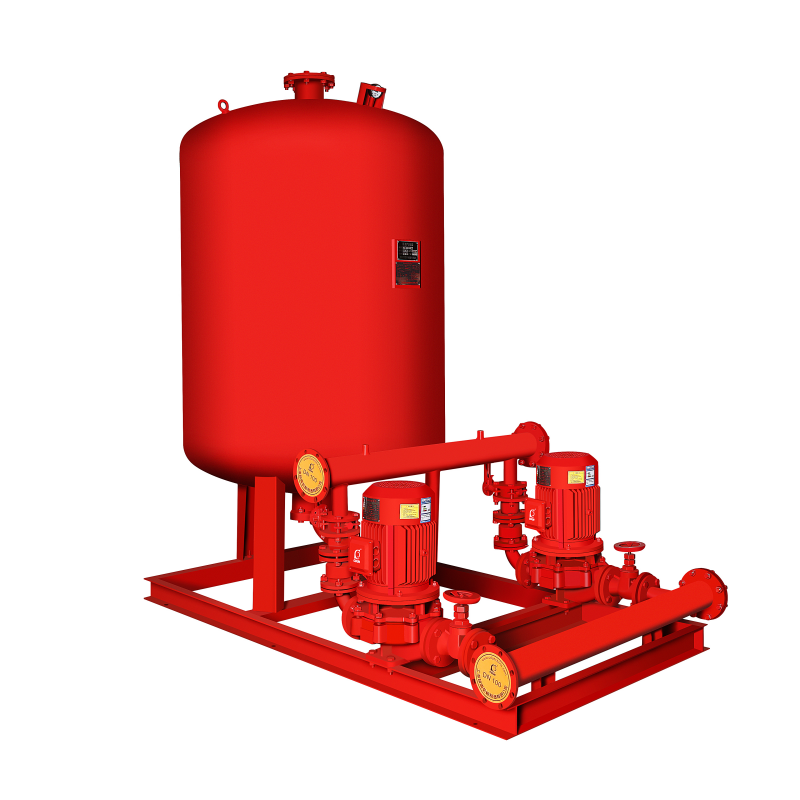
A complete residential booster package is more than a single pump. It normally combines four elements working together: the main fire pump (electric motor or diesel engine driven), a small jockey pump that holds standby pressure so the main pump does not short-cycle, a diaphragm pressure tank that buffers pressure swings and releases the first seconds of water, and a controller with pressure sensors that starts and stops the set automatically. A good example of this integrated approach is CDUN Pump’s ZW Series fire protection booster pump and pressure stabilization equipment, which packs the booster pump, control cabinet, pressure tank, and piping into one skid.
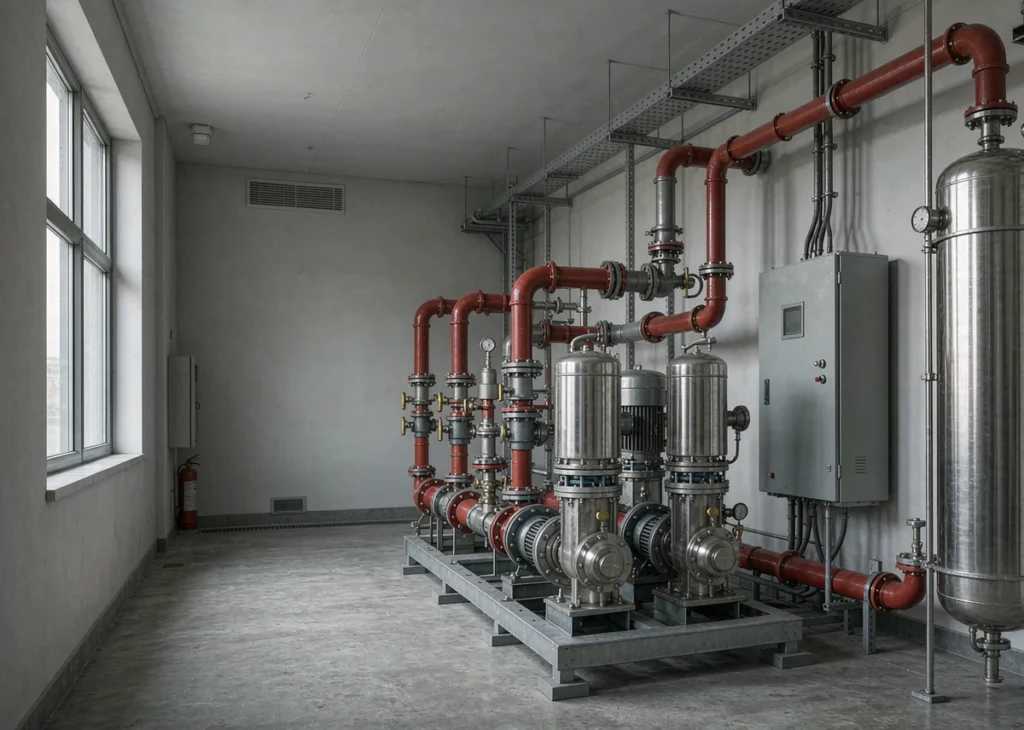
You will see the terms home fire sprinkler pump, residential fire pump, and fire sprinkler booster pump used almost interchangeably on site. The practical distinction is scope. A residential fire pump is any pump dedicated to fire protection in a residential building, while a booster pump describes its specific job — making up pressure that the supply cannot provide on its own. Most residential systems only ever need the booster function, which is exactly why the two terms overlap so often.
Two code families drive the design. In North America, NFPA 13D governs one- and two-family dwellings, NFPA 13R covers low-rise residential buildings up to four stories, and NFPA 20 sets the rules for the fire pump itself — its driver, controller, and performance curve. In China and many export markets, GB 50974-2014 defines fire water supply and hydrant requirements and GB 6245 defines fire pump performance and testing. Confirming which standard your project must satisfy is the first input to every sizing decision that follows.
Do You Need a Booster Pump? (Pressure Test)
The question “do I need a fire pump for my house?” is answered by measurement, not by opinion. Everything comes down to one comparison: the pressure your supply can deliver at the most unfavorable sprinkler head versus the pressure your design requires at that same head. You do not estimate this — you measure it.
The test is straightforward. Fit a calibrated pressure gauge with a flow valve to a hydrant or test connection near the base of the riser and record the static pressure with no water flowing. Then open the valve and record the residual pressure while water flows at a representative rate. Next, account for elevation: every 1 m of rise costs roughly 0.01 MPa (about 0.43 psi per foot). Subtract that elevation loss and the pipe friction loss from the residual reading. If the result falls below the minimum pressure your sprinkler head needs to produce its design density, a booster pump is required.
| What your pressure test shows | What it means | Typical action |
|---|---|---|
| High static pressure, and it barely drops when you flow water | The supply is adequate for your design demand | No booster pump needed |
| Static pressure fine, but residual pressure drops below the required head pressure when flowing | The supply cannot hold pressure under demand | Booster pump required |
| Static pressure already below the required head pressure at the top floor | Elevation loss has overwhelmed the supply | Booster pump required, sized for full head |
| Pressure is adequate for a small sprinkler system but marginal once a combined sprinkler and hydrant system is added | Combined demand exceeds what the supply can deliver at design flow | Booster sized for the larger combined demand |
Quick Check: Do You Need a Booster Pump?
Run this four-point check before you request a pump selection. Two or more “yes” answers mean you should plan for a booster and confirm it with a hydraulic calculation.
- Static pressure at your riser test valve is already below the pressure your sprinkler design needs at the head.
- Residual pressure drops sharply the moment you flow water at a representative rate.
- Your building is more than two stories, or your sprinkler heads sit well above the water supply.
- Your supply comes from a gravity tank or stored reservoir, not a high-pressure municipal main.
One important caution: a booster pump cannot fix a supply that simply does not have enough water. If your test shows plenty of pressure but the flow collapses the instant you open the valve, the problem is volume, not pressure — and you may need a storage tank or a larger service connection before a pump will help. Always confirm the final decision with a full hydraulic calculation before you commit to a pump model.
|
Not sure whether your project needs a booster? Send us your building height, supply pressure, and sprinkler demand. Our engineers will tell you — honestly — whether you need a pump, and which one fits. |
Why Might Your Home Need a Booster?
A residential fire sprinkler system needs a booster for one of a handful of reasons, and in real projects these rarely arrive one at a time. Understanding which ones apply to your building tells you what the pump actually has to do.
Elevation and building height. This is the most common driver. Pressure falls by roughly 0.01 MPa for every metre of rise, so the sprinkler heads on the top floor of a mid- or high-rise residential building see far less pressure than the supply delivers at ground level. On a tall building the elevation loss alone can exhaust a perfectly good municipal supply.
Long or complex pipe runs. Friction loss accumulates along every metre of pipe and through every fitting, valve, and backflow preventer. A large residential block with long horizontal mains can lose a surprising amount of pressure before water ever reaches the far end of the system.
Low municipal pressure or a gravity/store-fed supply. Older or undersized municipal networks, hillside and remote developments, and buildings fed from a rooftop tank or a stored reservoir all depend on pressure that is far lower than a modern city main. A tank-fed system relies on elevation alone, which makes a booster pump almost inevitable once the building grows.
Combined system demand and code upgrades. When a sprinkler system shares a supply with a hydrant or standpipe network, the design flow rises sharply and the supply has to serve all of it at once. Similarly, a retrofit that moves a building into NFPA 13R or introduces a new local requirement often pushes the existing supply below the new threshold. For your business, these triggers are exactly the moments when a correctly specified booster protects the whole project schedule.
How Does a Fire Booster Pump Work?
A fire booster pump is automatic and reacts to pressure, never to a person. The sequence runs the same way in almost every residential system:
- Standby pressure monitoring. The controller reads the fire main pressure through a sensing line, and the jockey pump keeps the system between its start and stop set points so small fluctuations never wake the main pump.
- Pressure drop detected. A sprinkler head fuses or a hose valve opens. Pressure in the main falls below the start set point, and the controller registers it instantly.
- Main pump starts. The controller energises the main pump — an electric motor or a diesel engine. Diesel units are chosen where grid power cannot be guaranteed; our guide to how a diesel fire pump works walks through that automatic start sequence in detail.
- Flow and pressure delivered. Inside the casing, a rotating impeller flings water outward and the volute converts that velocity into usable pressure. A check valve keeps water from flowing back into the supply.
- Pressure stabilisation. The diaphragm tank and, on many units, a variable-frequency drive hold the discharge pressure steady. CDUN’s ZW Series, for example, is specified to hold constant pressure to within ±0.01 MPa at the operating point.
- Run until shutdown. An electric set stops when pressure is restored and the controller timer elapses; a diesel unit is typically run until a person shuts it down, so it stays available for the full duration of an event.
Almost every residential booster pump relies on a centrifugal impeller to generate head. If you want the fundamentals behind the most common pump family before you compare models, our explainer on the end suction pump working principle covers how one impeller turns rotation into pressure and flow.
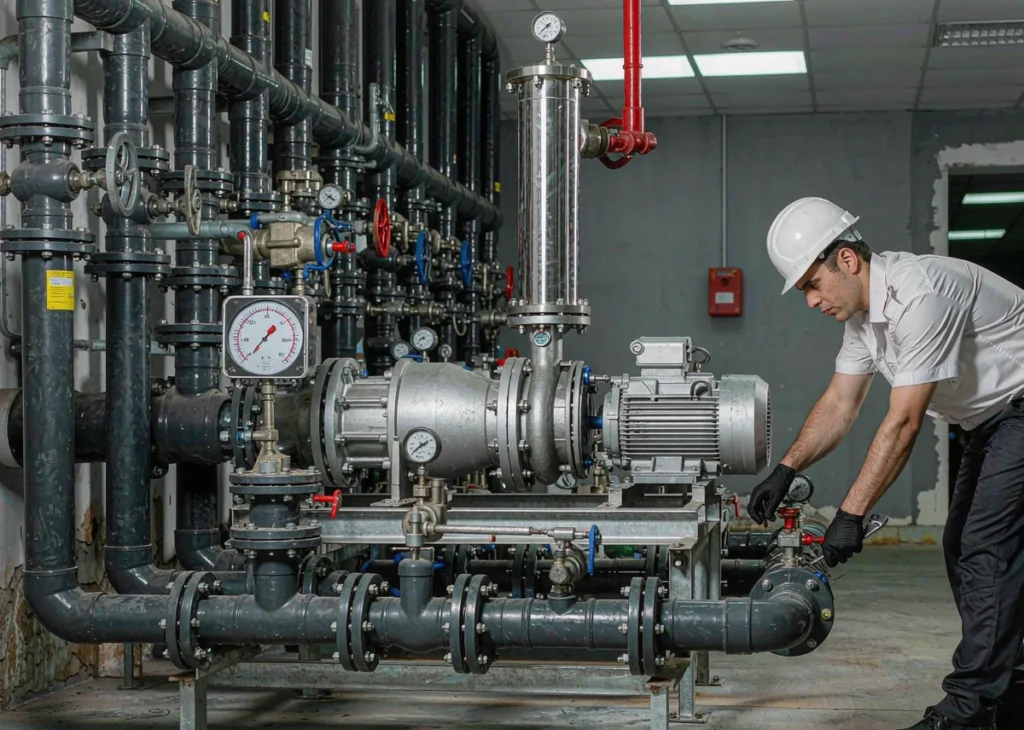
How to Size a Residential Fire Pump
Fire pump sizing answers two numbers: how much water, and at what pressure. Flow (measured in L/s or GPM) comes from your hydraulic calculation — it depends on how many sprinklers are expected to operate at once, the design density, and the hazard or occupancy class. Head (pressure) is built up from four parts: the pressure required at the most unfavorable sprinkler head, the friction loss through piping and fittings, the elevation loss to that head, and a safety margin.
Flow and head are linked by the pump curve — as flow rises, head falls. This is why you cannot simply pick the pump with the biggest numbers. NFPA 20 requires a fire pump to deliver at least 150% of its rated flow at not less than 65% of its rated head, so you must select a curve whose shape covers your system demand with margin, not a single point on a datasheet.
Required pump head — the four things you add up
Required head = pressure needed at the most unfavorable sprinkler head + friction loss in piping and fittings + elevation loss (≈ 0.0098 MPa × height in metres) + margin.
The table below shows how a building’s demand profile maps onto a pump family. The head bands and flow ranges are drawn from real CDUN product ratings, but your exact figures must still come from a hydraulic calculation for the specific building.
| Application | Demand profile | Typical head band | Pump family that fits |
|---|---|---|---|
| Single-family or low-rise residential | Light flow, short runs | Low head | ZW Series booster & pressure-stabilization set (0.6 / 1.0 / 1.6 MPa) |
| Mid-rise residential with elevated heads | Moderate flow, notable elevation | Medium to high | Vertical Multistage Fire Pump CDL |
| High-rise with long vertical risers | Moderate to high flow, high elevation | High head (30–300 m) | Vertical multistage fire pump |
| Combined sprinkler & hydrant network | High flow, high elevation | High head, large flow (5–200 L/s) | Fire Pump Series — split-case or larger end-suction units |
Then think about the plant room itself. In a tight residential basement, a vertical pump saves floor space because it stacks the stages instead of laying them out along a baseplate — the CDL vertical multistage fire pump is designed around exactly that constraint. If you are still weighing the trade-offs between the two layouts, our comparison of horizontal vs vertical centrifugal pumps covers footprint, head capability, and maintenance access side by side.
|
Have your flow and head figures ready? See the packaged booster and pressure-stabilization unit that keeps residential sprinkler pressure steady to within ±0.01 MPa. |
How to Install and Maintain It
Good installation protects everything the sizing work was meant to achieve. Mount the set level on a firm base in a dry, ventilated plant room and keep the space above freezing — a typical operating window is 0 to 40°C. Use vibration isolators under the frame, and on a vertical pump check that the shaft is plumb to within about 0.5 mm per metre so the seals do not wear prematurely.
On the piping side, fit flexible rubber joints at the inlet and outlet so pipe stress never reaches the pump body, and give the suction and discharge lines their own supports. A check valve on the discharge and a test/bypass line make flow testing far easier later. Electrically, give the set its own circuit, add dual power where the code requires it, and confirm grounding resistance is at or below 4 Ω. If your supply is drawn from a tank or a well rather than a pressurised main, the self-priming pump working principle is worth understanding before you choose the suction arrangement.
At commissioning, set the pressure tank pre-charge to roughly 70–80% of the system working pressure, set the start and stop points, run the constant-pressure test, simulate the fire signal linkage, and record the pressure, current, and switching-time data. From that point on, maintenance is a schedule, and NFPA 25 lays out the cadence your business should follow.
| Interval | What to check | Why it matters |
|---|---|---|
| Weekly | Visual walk-round: leaks, unusual noise or vibration, gauge readings, jockey pump cycling | Catches developing faults before they become failures |
| Monthly | Record suction and discharge pressures; verify jockey pump start/stop; check controller alarms | Confirms the set points are still holding standby pressure |
| Annually | Full flow test at churn, rated, and 150% of rated flow; inspect pressure tank pre-charge | Proves the pump still matches its original performance curve |
| Annually | Check couplings and lubrication; on diesel units, test batteries and fuel quality | Prevents the most common cause of start failure |
| After any fire event or repair | Re-test the set and re-confirm the set points; update the log | Restores documented proof of performance after the system has run |
Keep a written log for every test. Insurers and inspectors expect a complete history, and a documented maintenance record is often the difference between a smooth acceptance and a stalled handover. Your business should treat the log as part of the delivered system, not as an afterthought.
FAQs
Do I need a fire pump for my house?
Only if a pressure test proves your supply cannot deliver the required pressure at the most unfavorable sprinkler head. Run a static and residual pressure test at the riser, subtract the elevation loss (about 0.01 MPa per metre) and the pipe friction loss, and compare the result with the pressure your design requires at the head. If the supply falls short, a booster pump is needed; if it comfortably meets the figure, it is not. A single-family home on a strong municipal main often needs no pump at all, while a three- or four-storey building with rooftop heads frequently does.
How much does a residential fire pump cost?
Residential fire pump cost is driven by duty, not by a single list price, so two projects with the same building size can land far apart. The main drivers are the pump type and driver (electric is generally less expensive than diesel), the flow and head rating, whether pressure stabilization is included, the level of control and monitoring, the materials of construction, and the installation and commissioning scope. Because the numbers scale with duty, the cheapest way to keep cost under control is to size the pump accurately from a hydraulic calculation instead of over-specifying it “just in case”.
| Cost factor | Why it moves the price |
|---|---|
| Pump type & driver | Electric vs diesel; multistage vs single-stage construction |
| Flow & head rating | A larger duty means a larger motor, casing, and curve |
| Pressure stabilization scope | Jockey pump and diaphragm tank add cost but protect the main pump |
| Controls & monitoring | VFD constant pressure, dual power, and remote monitoring are options |
| Materials | Cast iron vs 304/316 stainless steel for the wetted parts |
| Installation & commissioning | Piping, electrical work, and testing; an integrated skid cuts site labour |
What size fire pump do I need for a residential sprinkler system?
Fire pump sizing starts with your hydraulic calculation, which gives the design flow and the required pressure at the most unfavorable sprinkler head. Add the friction loss through the piping and fittings, the elevation loss to that head, and a margin, and you have your required head. Then choose a pump whose curve covers that duty — remembering that NFPA 20 requires 150% of rated flow at not less than 65% of rated head. There is no shortcut based on building size alone; a compact single-family system and a combined sprinkler and hydrant network in the same tower can demand very different pumps.
What is the difference between a fire sprinkler booster pump and a jockey pump?
They do two different jobs. The main booster pump is the large unit that supplies the full design flow and pressure during an actual fire. The jockey pump is a small, low-flow pump that only tops up the system to offset small leaks, keeping the pipework pressurised so that a minor pressure dip does not start the large main pump and wear it out through short-cycling. Most residential systems need both, and they share the same controller and pressure tank.
Can a residential fire booster pump run from a gravity tank or storage reservoir?
Yes, and this is one of the most common reasons a booster is specified in the first place. A tank- or reservoir-fed system relies on elevation alone for its pressure, so it is especially sensitive to building height and pipe friction. The booster pump sits downstream of the tank and raises the pressure to the level the sprinkler design requires. Just confirm the tank can supply enough volume at the needed flow rate — a booster adds pressure, not water.
How often should a residential fire pump be tested?
Under NFPA 25 the cadence is weekly, monthly, and annual. Run a weekly visual walk-round and, on engine-driven sets, a no-flow run; each month record the pressures and verify the jockey pump start and stop; and once a year carry out a full flow test at churn, rated, and 150% of rated flow and compare the results with the original performance curve. Document every test, because insurers and inspectors expect a complete history for your fire pump.
Should I choose an electric or a diesel booster pump for a residential building?
Match the driver to your power reliability. An electric-driven pump is the simpler, lower-maintenance, lower-cost choice wherever the grid is stable and a code-compliant backup supply exists. A diesel-driven pump is the better answer where grid power cannot be guaranteed, or where the building has no generator that meets the code, because it keeps working through an outage. If your project needs both, a combined diesel-and-electric set gives you flexibility in a single packaged unit.
Conclusion
A residential fire sprinkler booster pump is only as good as the decision behind it. Start with a pressure test, confirm the result with a hydraulic calculation, size the pump to the real flow and head, and install and maintain it to a documented schedule. Do that, and your sprinkler system will deliver the pressure it was designed for at the exact moment it is needed — which is the only moment that matters.
|
Ready to specify your residential fire booster pump? Tell us your building height, supply conditions, and sprinkler demand. We will recommend the right pump and support your project from selection to delivery. |