
What is a VFD in pumps, and why does it keep coming up whenever procurement teams talk about cutting operating costs? If your facility runs a variable frequency drive pump, a centrifugal booster set, a submersible well pump, or a packaged water-supply skid, a VFD is one of the highest-return upgrades you can make. Instead of forcing the motor to run flat-out at a fixed 50/60 Hz and throttling the excess away with valves, a VFD lets you match motor speed to real-time demand. For your business, that shows up directly as lower electricity bills, gentler starts, tighter pressure control, and fewer emergency repairs. In the sections below, you will learn exactly what a VFD is, how it controls a pump, how much energy it can save, which pump types it works with, how to size one, and how to avoid the common problems that catch buyers off guard.
What Is a VFD in Pumps?
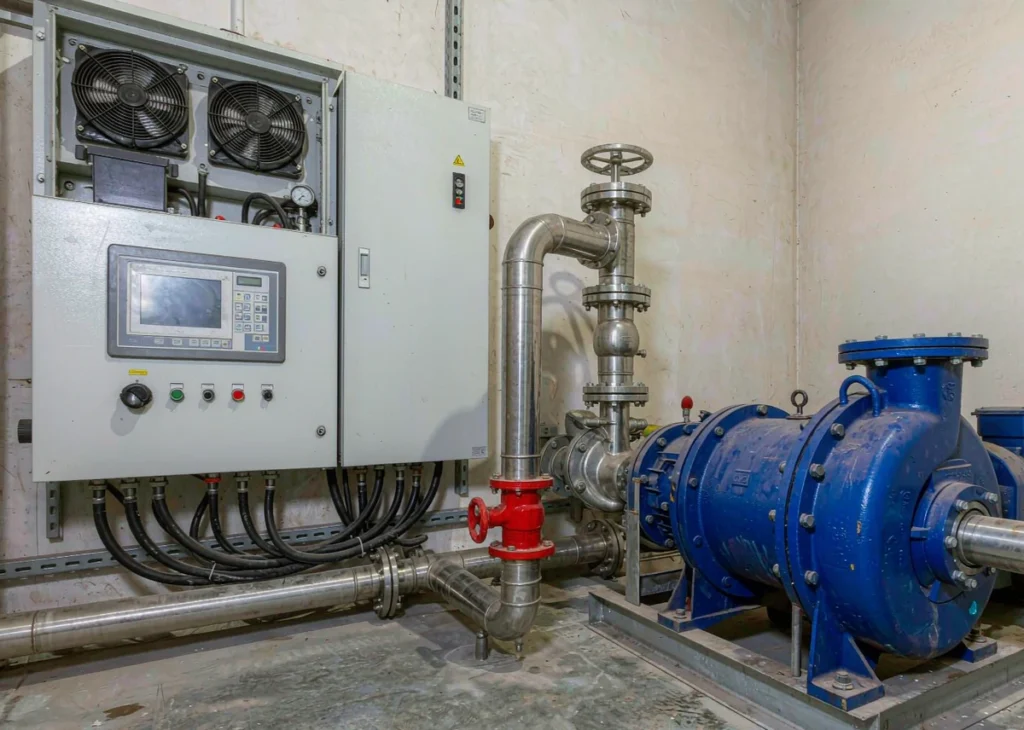
When engineers ask “what is VFD in pumps,” they mean a pump whose motor speed is controlled electronically instead of running at a fixed line frequency. A VFD in a pump system is a solid-state electronic controller that changes the frequency and voltage supplied to the motor. Because an AC induction motor’s speed is set by the supply frequency—expressed by the equation N = 120 × f ÷ P (where N is RPM, f is frequency, and P is the number of pole pairs)—lowering the frequency slows the pump and raising it speeds the pump up. In plain terms, a variable frequency drive pump is a pump whose motor is fed a variable-speed signal rather than a fixed line frequency. The drive sits between your power supply and the motor, converting incoming AC to DC on a bus and then synthesizing a precisely controlled AC output.
When you pair that drive with a pressure or flow sensor and a PID control loop, the result is a variable speed pump drive that automatically trims output to exactly what your process needs—nothing more. This is the core reason a VFD pump controller has become standard on modern water-supply and booster systems, where demand swings hour to hour and the cost of over-pumping is paid every single day on your energy bill.
How Does a VFD Control a Pump?
If you have ever asked how does a VFD work on a pump, the mechanism is straightforward. Understanding how a VFD works on a pump helps you specify and commission it with confidence. The drive takes fixed grid power, rectifies it to DC, smooths it on the DC bus, then uses fast IGBT switches to recreate an AC waveform at whatever frequency the controller demands. As frequency drops, motor RPM drops, and—by the pump affinity laws—flow falls in proportion to speed, head falls with the square of speed, and power falls with the cube of speed. That cubic relationship is the single most important fact in this entire guide: a modest 20% speed reduction can cut power draw by roughly half.
A modern VFD pump controller reads a feedback signal (a pressure transducer, flow meter, or level sensor), compares it to your setpoint, and adjusts output frequency dozens of times per second to hold the target. Soft-start and soft-stop ramps replace the violent across-the-line start (6–8× inrush current) that shocks seals, couplings, and piping. On a CDUN VFD unit, that closed-loop logic also drives multi-pump rotation, sleep mode during low demand, and built-in protections such as dry-run, phase-loss, over-temperature, and over/under-voltage—features your business would otherwise have to bolt on separately.
Why Use a VFD on a Pump?
For most B2B buyers, the decision comes down to a short list of operational and financial benefits. A VFD non-negative pressure water supply equipment package, for example, turns those benefits into a single commissioned skid rather than a pile of loose components. The reasons to add a drive are:
- Energy savings you can measure. Because power scales with the cube of speed, trimming motor RPM during partial-load periods directly attacks your biggest recurring cost. CDUN’s VFD water-supply units are rated for 20%–50% lower comprehensive energy consumption and 30%–60% lower annual electricity cost versus conventional tank-based systems.
- No more water hammer. Smooth acceleration and deceleration eliminate the pressure spikes that crack joints, fatigue pipes, and shorten valve life.
- Precise pressure and flow. Closed-loop control holds your setpoint to within ±0.01 MPa, so terminal users never feel the surge and sag of on/off pumping.
- Longer equipment life. Fewer starts, less vibration, and lower sustained temperatures extend the service life of seals, bearings, and the motor itself.
- Built-in protection. Dry-run, phase-loss, over-temperature, and stall protection cut the risk of a single fault turning into a burned-out motor.
- Process flexibility. One drive adapts to seasonal demand, future expansion, and changing duty points without re-piping the whole system.
|
Explore CDUN’s VFD Pump Solutions See how a packaged VFD drive turns energy savings and constant pressure into a commission-ready unit for your project. |
How Much Energy Can a Pump VFD Save?
This is the question every finance and operations manager asks, and the answer is grounded in the pump affinity laws rather than marketing. Because power is proportional to the cube of speed, even small speed reductions produce large energy savings. The table below shows the relationship for a pump already sized near its best efficiency point:
| Motor speed | Relative power draw | Energy saved vs full speed |
|---|---|---|
| 100% | 100% | Baseline |
| 90% | ~73% | ~27% |
| 80% | ~51% | ~49% |
| 70% | ~34% | ~66% |
Real-world pump VFD energy savings typically land in the 20%–50% range for variable-demand systems such as buildings, irrigation, and municipal supply, and your vfd pump payback period commonly falls between 12 and 36 months once you factor in reduced maintenance.
What Types of Pumps Can Use a VFD?
Variable speed control works best on centrifugal and axial machines, where the affinity laws apply. A centrifugal pump vfd application is the textbook case: because power scales with the cube of speed, even modest trimming pays back fast. The table below shows how the major pump families line up, and where you need to pay attention. If you are still deciding between orientations for a centrifugal machine, our guide to the horizontal vs vertical centrifugal pumps breaks down the space and maintenance trade-offs.
| Pump type | VFD suitable? | What to watch |
|---|---|---|
| Centrifugal (horizontal / vertical) | Yes — excellent | Match NPSH margin; most duties need no special care |
| Submersible pump (well, sewage) | Yes | Use a VFD-rated motor, correct cable length, avoid low-speed clogging |
| Multistage | Yes | Avoid dwelling at critical speed; verify rotor limits |
| Positive displacement | Generally no | Fixed torque; a VFD adds cost with little benefit |
| Booster / packaged skid | Yes — designed in | Confirm PID sensor and sleep logic are commissioned |
For a VFD for submersible pump duty specifically, the motor must be inverter-rated and the cable run must be within the drive’s allowed length (or fitted with an output reactor) to prevent voltage reflection damage. Well and deep-lift applications also benefit from vector control to hold torque at low speed. Our sewage pump installation guide covers the mechanical side of getting a submersible set online safely.
How to Size and Select a Pump VFD
Sizing a drive is mostly about respecting the motor’s nameplate and your site conditions, whether you buy a vfd pump control panel or a packaged skid. A VFD pump controller or a constant pressure VFD water supply equipment package removes most of this work, but you should still confirm the following before you place an order:
- Match the motor nameplate. Note rated kW/HP, voltage, phase, pole count, and full-load amperage (FLA).
- Add headroom. Size the drive to at least 110%–120% of motor FLA to absorb peak torque and reduce heat stress.
- Apply derating. Above 1,000 m altitude or in ambient temperatures over 40°C, derate the drive or add forced cooling.
- Pick the control mode. V/f control suits most pumps; flux vector control holds torque better for deep-well and submersible duty.
- Plan for harmonics. On drives above roughly 50 kW, or where the utility sets power-quality limits, bundle a 3% line reactor.
- Confirm the enclosure. IP54 for the cabinet and IP55 for the pump set is a sensible baseline for plant-room and outdoor use.
- Integrate sensors and logic. A 0.1-class pressure transmitter plus PLC PID gives you the ±0.01 MPa accuracy modern units promise.
If your team prefers a deeper look at pump selection fundamentals first, our single-stage centrifugal pump guide walks through flow, head, and efficiency before you pair a drive to the machine.
Common VFD Problems and How to Avoid Them
This section also serves as a practical vfd pump troubleshooting checklist. A VFD is reliable when specified and installed correctly, but a few failure modes show up repeatedly across the industry. The table maps each problem to its usual cause and the preventive step your business should take during specification.
| Problem | Common cause | How to avoid |
|---|---|---|
| Motor overheating at low speed | Self-cooled motor run below base speed | Use an inverter-duty motor or add forced cooling |
| Harmonics / EMI | IGBT switching on long, unshielded runs | Line reactor + shielded cable; separate signal and power |
| Bearing fluting / noise | Shaft currents on larger motors | Insulated bearings or shaft-grounding ring (>7.5 kW) |
| Nuisance trips | Wrong parameters / protection setup | Commission with motor FLA, poles, ramp times |
| Cable length issues | Long motor leads | Output reactor / dv/dt filter |
| Undersized drive | Drive too small for the load | Size to ≥ motor FLA + 10–20% headroom |
FAQs
Can any pump use a VFD, or only certain types?
Centrifugal and axial pumps are ideal candidates because their power scales with the cube of speed, which is exactly what makes a VFD worthwhile. Submersible and multistage centrifugal pumps also work well with the right inverter-rated motor and cable planning. Positive displacement pumps are generally poor candidates because they are fixed-torque machines—the VFD adds cost without delivering the same savings. If you run a mixed fleet, start by retrofitting the highest-hour centrifugal duties first.
How much energy does a VFD actually save on a pump?
For variable-demand systems, expect 20%–50% lower energy consumption and, with intelligent sleep strategies, 30%–60% lower annual electricity cost. The exact figure depends on how far your duty point sits below the pump’s full-speed curve and how many hours per day you operate at partial load.
Is a VFD better than a soft starter for my pump?
A soft starter only reduces inrush current during startup and then hands the motor full line frequency—so you still run at fixed speed and throttle excess flow with valves. A VFD, by contrast, controls speed across the whole operating cycle, delivering pressure control and the energy savings this guide describes. If your only concern is gentle starting on a constant-demand transfer pump, a soft starter is cheaper; the broader vfd vs soft starter question is really about whether you need speed control at all. For any variable-demand application, the VFD vs constant speed pump comparison favors the VFD on lifecycle cost.
What size VFD do I need for my pump motor?
Start from the motor’s full-load amperage on the nameplate, then choose a drive rated at 110%–120% of that current. Add derating if the site is above 1,000 m altitude or the cabinet ambient exceeds 40°C. For deep-well or submersible duty, prefer flux vector control to hold torque at low speed, and confirm the drive supports the motor’s voltage and pole count.
Will a VFD cause harmonics or motor overheating?
Both are manageable. Harmonics from IGBT switching are addressed with a line reactor and shielded, properly separated cable runs; many utilities require this above a certain drive size. Low-speed overheating is avoided by using an inverter-duty motor or adding external cooling, since a standard fan-cooled motor loses airflow as it slows. These are specification decisions, not inherent flaws—which is why correct commissioning matters more than the drive brand.
How long does a pump VFD last, and what maintenance does it need?
In a clean, climate-controlled electrical room, a quality VFD typically lasts 15–20 years. The components that actually wear out are the DC-bus capacitors and the internal cooling fan, so schedule periodic inspection, keep filters clean, and replace the fan proactively. Protect the drive from dust, moisture, and heat, and most field failures simply will not occur.
Can I retrofit a VFD onto an existing fixed-speed pump?
Yes, in most cases. For smaller pumps (under about 5 kW) an integrated VFD pump is the cleanest swap; for larger motors you mount a separate drive panel near the motor, replace the motor cable with a screened type, and wire in a pressure or flow sensor. Confirm the existing motor is VFD-compatible—most modern three-phase motors are—and have the parameters set to the nameplate before energizing. Payback on a retrofit is usually driven by the energy saving alone.
Conclusion
A VFD in pumps is no longer a luxury feature—it is the standard way to turn a fixed-speed machine into a demand-responsive, energy-efficient, longer-lived asset for your business. You now know what a VFD is, how it controls speed through the affinity laws, how much it can save, which pump types it suits, how to size it, and how to avoid the handful of problems that catch unprepared buyers. The next step is to match a drive to your actual duty point and confirm the payback for your site.
|
Ready to Spec Your VFD Pump? Send CDUN Pump your flow, head, and duty profile and get a matched VFD unit or control cabinet with factory test data. |