Skip to content

When you specify a pump for a building, a treatment plant, or an industrial site, the pump itself tends to get all the attention. Yet the enclosure that starts, stops, and protects that motor — your pump control cabinet — is what keeps the whole system running safely, day after day. Choose the wrong one and your business faces nuisance trips, shortened motor life, failed compliance audits, and the kind of unplanned downtime that stalls a project.
This guide breaks down what a pump control cabinet does, the main types on the market, why your motor’s power and current ratings drive the specification, how to choose the right unit, and the standards and parameters most buyers overlook. You’ll finish with a practical checklist you can pass straight to your procurement or engineering team. If you’re still matching a pump to the job, our single-stage pump series covers the most common centrifugal builds you’ll pair with a control cabinet.
What Is a Pump Control Cabinet and What Does It Do?
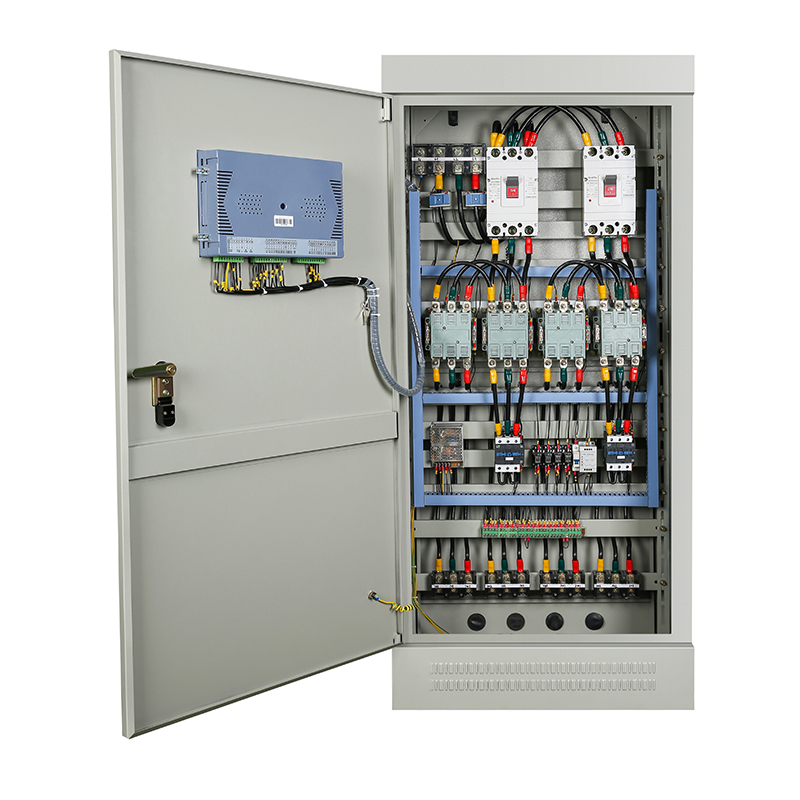
A pump control cabinet — also called a pump control panel, or, for smaller wall-mounted units, a water pump control box — is an enclosed assembly of electrical components that controls one or more pumps. At its simplest, it receives a command (from a pressure switch, float switch, level sensor, PLC, or building-management system) and switches the motor on or off.
In practice, a modern cabinet does far more than switch:
- Start and stop control — direct, soft, or variable-frequency starting to suit the application and protect the motor.
- Protection — overload, overcurrent, phase-loss, under/over-voltage, and dry-run protection that prevents catastrophic motor failure.
- Monitoring and alarms — fault codes, audio-visual alarms, and on smarter units, telemetry that lets your team see status remotely.
- Process control — on VFD cabinets, automatic speed regulation holds constant pressure or flow without wasting energy.
You’ll hear “cabinet,” “panel,” and “box” used almost interchangeably by suppliers. Conventionally, “cabinet” implies a larger floor- or wall-mounted enclosure, while “box” often describes a compact unit — but the function is the same, so judge the device by its ratings, not its label.
What Types of Pump Control Cabinets Are There?
By Starting Method
The starting method is the single biggest factor in cost, energy use, and motor stress. Here is how the four common approaches compare:
| Starting Method | Best For | Typical Motor Range | Key Benefit | Watch-Out |
|---|---|---|---|---|
| Direct-on-Line (DOL) | Simple, fixed-speed small pumps | ~0.75–7.5 kW | Lowest cost, simplest wiring | 5–7× inrush current; water hammer |
| Star-Delta | Medium motors, reduced inrush | ~7.5–55 kW | Lower start current than DOL | Torque dip during transition |
| Soft Starter | Smooth start/stop, no speed control | ~5.5–160 kW | Tames inrush; cuts water hammer | No energy saving at part load |
| VFD (Variable Frequency) | Constant pressure, energy saving | 0.55–315 kW | Speed control + big OPEX savings | Higher cost; needs commissioning |
Pick the method that matches your duty. A soft starter or VFD tames inrush current and reduces water hammer, which protects both the motor and the pipework your business has already invested in. For an integrated, automated example, our CDK series automatic pump control cabinet combines soft-start logic with real-time monitoring and a design life of 10+ years.
By Application
The same electrical building blocks are packaged differently depending on where the cabinet works:
- Fire pump control panel — built for life-safety duty. In North America these follow NFPA 20 and are typically UL 508A listed; in China, GB 50974 applies. Fail-safe manual override is non-negotiable.
- Water-supply and booster systems — variable-frequency control holds constant pressure across a building or district network.
- Sewage and drainage — level-based automatic start/stop with pump alternation to even out wear.
- HVAC and industrial circulation — chilled-water, cooling-water, and process pumps with scheduled or lead-lag operation.
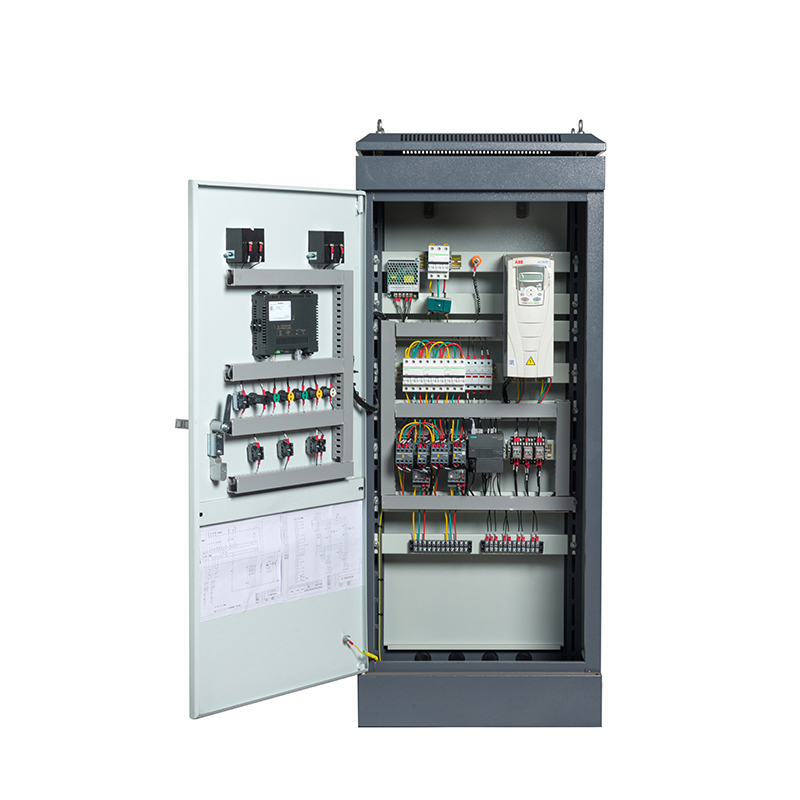
For applications that need precise speed control, a VFD pump control cabinet such as our CDBK series adjusts motor speed to live demand and can cut energy use substantially across water supply, HVAC, and fire-auxiliary duties.
Why Do Motor Power and Current Decide the Cabinet?
Every component inside the cabinet — contactors, breakers, overload relays, and the VFD itself — is sized from your motor’s electrical ratings. Two numbers matter most:
- Rated power (kW) sets the frame size of the switching devices.
- Full-load and starting current determine cable cross-section, thermal-overload setting, and VFD current rating. A direct-on-line start can draw 5–7× full-load current, so a cabinet sized only on kW will trip or overheat.
Voltage class (380/400/415/480 V), phase, and service factor all feed the calculation. Oversize and you waste capital; undersize and you create a genuine fire and reliability risk. If your duty is continuous — for example, a borehole or submersible pump running for long stretches — the cabinet must be rated for 100% continuous current, not just intermittent duty. Our guide on how long a submersible pump can run continuously explains why continuous-rated assemblies matter for motor life.
How to Choose a Pump Control Cabinet
Work through these steps and you’ll narrow the field quickly:
- Define the pump duty. Record rated power, supply voltage, full-load current, and the starting method your application allows.
- Match the application. Fire, water-boost, sewage, and HVAC each impose different control logic and standards. The pump type you pair it with — for instance, an end suction pump — changes the control logic you need.
- Choose the control mode. DOL for simple small duties; soft starter or VFD where inrush, water hammer, or energy savings matter.
- Specify the enclosure. IP54 suits indoor dry rooms; IP65 is the safer call for outdoor, washdown, or humid sites.
- Confirm standards and documentation. Require CE/UL markings, ISO 9001 manufacture, and test reports matched to your market.
- Plan for growth. Lead-lag alternation, telemetry (RS485/4G), and modular I/O save a costly re-build later.
| Need a VFD cabinet that pays for itself in energy savings? The CDBK series covers 0.55–200 kW with constant-pressure control for water, HVAC, and fire-auxiliary duties. |
5 Standards and Parameters Buyers Often Miss
Most specifiers check the kW rating and stop. These five are where projects get caught out:
| Standard / Parameter | Region / Scope | What It Covers | Why It Matters |
|---|---|---|---|
| IEC 61439 | International | Low-voltage switchgear assembly safety & verification | Proves the assembly is designed and tested as a whole |
| IEC 60529 (IP rating) | International | Ingress protection against dust and water | Wrong IP rating = premature failure in humid sites |
| NFPA 20 & UL 508A | North America | Fire pump controller requirements & listing | Mandatory for code-compliant fire pump control panel jobs |
| GB 50974 | China | Fire water supply engineering specifications | Required for China-market fire pump projects |
| Short-circuit withstand & derating | All markets | Fault capacity; temp/altitude de-rating rules | Ignoring derating causes hidden overload at site |
Don’t let a missing certification or an un-rated short-circuit withstand become your site’s weak point — confirm each one against your local code before you issue the purchase order.
FAQs
Is a pump control cabinet the same as a pump control panel?
Essentially yes. “Cabinet,” “panel,” and “box” describe the same class of motor-control assembly; the words mostly reflect size and mounting style. Specify by electrical ratings and standards, not by the label your supplier uses.
How do I size a control cabinet for my motor?
Start from the motor’s rated power (kW) and full-load current, then add margin for starting current and ambient temperature. A VFD or soft-starter cabinet must be rated for the motor’s continuous current, not just its nameplate power.
Do I need a VFD or a soft starter?
Choose a soft starter when you only need to limit inrush and water hammer. Choose a VFD when you also want variable speed for constant pressure, energy savings, or soft acceleration across a wide load range.
Which standards apply to a fire pump control panel?
In North America, NFPA 20 defines the fire-pump controller requirements and units are typically built to UL 508A (often UL listed). In China, GB 50974 governs. Both demand fail-safe manual override and segregated control power.
Can one cabinet control multiple pumps?
Yes. Modern cabinets support duty/standby, multi-pump parallel, and timed alternation (lead-lag) to balance runtime and prevent standby-pump corrosion. Confirm the cabinet’s pump-count rating and alternation logic before purchase.
IP54 or IP65 — which enclosure should I specify?
IP54 protects against limited dust and splashing water — fine for indoor switch rooms. IP65 resists jets and heavier dust, making it the right choice for outdoor, plant, or washdown environments. Match the rating to the worst condition the cabinet will see.
| Pump Control Cabinet — Pre-Purchase Checklist ✓ Motor rated power (kW) and full-load current recorded ✓ Starting method matched to duty (DOL / star-delta / soft / VFD) ✓ Application logic confirmed (fire / water / sewage / HVAC) ✓ Enclosure rating (IP54 vs IP65) set by site conditions ✓ Standards verified (IEC 61439, NFPA 20 / UL, GB 50974) ✓ Telemetry & alternation planned for future expansion |
Conclusion
A pump control cabinet is a small line item that protects a far larger investment. Get the starting method, motor ratings, application logic, enclosure, and standards right, and your pumps will start first time, every time — with the documentation to prove compliance. Use the checklist above, shortlist two or three candidates against your duty, and involve your panel supplier early so the control logic matches the pump.
| Specifying a pump control cabinet for your next project? Browse automatic and VFD cabinets built to IEC, UL, and ISO standards — with OEM and custom options. |